Paper alert!
When the placenta provides a blueprint for managing chronic inflammation
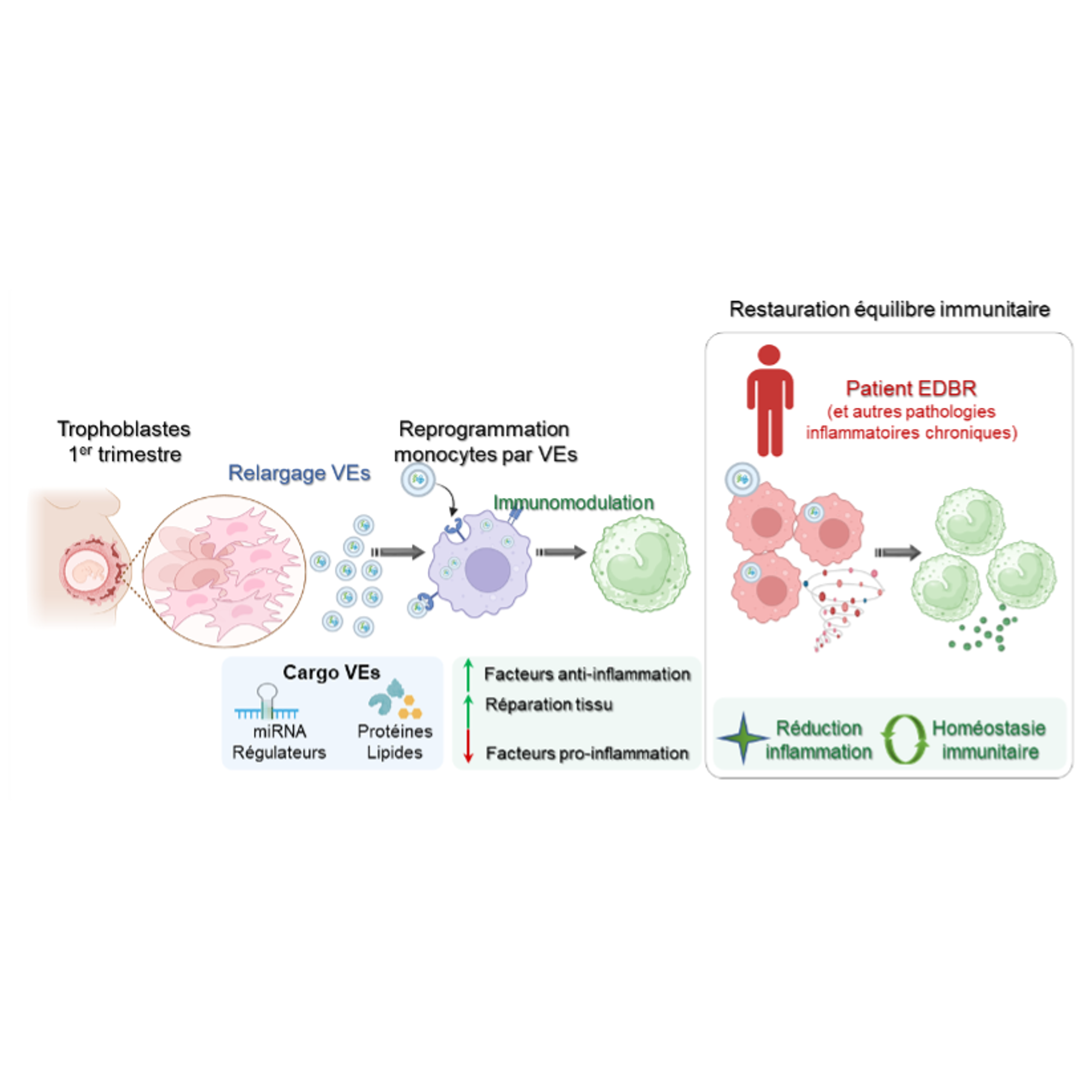
Nell Hirt, Enzo Manchon and Ming Wu, under the supervision of Reem Al Daccak (IRSL Team Skin Immunity and Inflammation, headed by Jean-David Bouaziz) and Nabila Jabrane-Ferrat (Institute for Infectious and Inflammatory Diseases, Toulouse, France), have investigated whether the placenta’s unique ability to regulate inflammation could be harnessed outside pregnancy. Focused on placenta-derived extracellular vesicles (PEVs) released by extravillous trophoblasts, they used a stable human trophoblast model to generate PEVs and investigated their effects on circulating human monocytes, key drivers of inflammatory responses. Integrated molecular analyses revealed coordinated changes in immune and metabolic pathways, suggesting that these EVs do not simply suppress inflammation, but rather redirect immune-cell function towards a state more compatible with tissue homeostasis and repair.
Strikingly, PEVs also modulated the inflammatory bias of monocytes from patients with recessive dystrophic epidermolysis bullosa (RDEB), a rare genetic disorder characterized by persistent inflammation and ongoing tissue damage, promoting changes consistent with a restoration of immune balance.
Together, these findings bring placental biology, immune reprogramming and reproducible PEV production into an interesting translational perspective. Rather than simply blocking inflammation, could we learn to redirect it towards resolution and tissue repair?
These findings do not yet demonstrate a treatment for chronic inflammatory disease, they rather reveal something potentially more fundamental: the placenta naturally produces extracellular messages capable of reprogramming inflammatory immune cells—and these messages remain active outside pregnancy, even in cells from patients with chronic inflammatory disease. It may therefore provide a biological blueprint for redirecting chronic inflammation towards immune balance, tissue homeostasis and repair, rather than simply suppressing the inflammatory response.
Congratulations to all the authors and the collaborators, scientists and clinicians, who contributed to this study that is now published in the Journal of Extracellular Vesicles.
Enjoy the read!